
Hire Product Designers in India: 2026 Guide
As of June 2026, teams in India that need to hire product designers are usually choosing between three real options: a full-time hire, a freelance specialist, or a sprint-based partner. The right call depends on how fast you need output, how complex the product is, and whether you need ongoing product design or just a focused burst of delivery. For teams thinking about Resume Trends 2026, that same signal-first mindset applies to hiring too: look for proof, clarity, and outcomes.
Key takeaways
- The best hiring model for product design depends on speed, scope, and how much design work will continue after the first project.
- A strong product designer portfolio proves product judgment, not just polished screens.
- India hiring gets easier when the role scope separates UX design, UI design, and design systems work.
- Sprint-based product design partners fit short, high-stakes projects better than permanent headcount.
Should you hire product designers in-house, freelance, or as a sprint-based partner?
The fastest way to choose is to match your design need to your product stage, not to a trendy hiring model. Early-stage startups usually need speed and focus, scaling SaaS teams need consistency, and product orgs with a large roadmap usually need in-house ownership. If you are trying to hire product designers in India, the real question is whether you need a builder, a specialist, or a short-term execution layer.
| Hiring model | Best for | Watch out for | India-specific fit |
|---|---|---|---|
| In-house product designer | Ongoing roadmap work, design systems, cross-functional ownership | Slower to hire, higher fixed cost, harder replacement | Best when the team has stable product demand and can support a full-time role |
| Freelance product designer | One-off features, small UX fixes, overflow work | Context switching, inconsistent availability, weak long-term ownership | Works well for short bursts if the brief is tight and the designer is senior |
| Sprint-based product design partner | MVPs, redesigns, product experiments, urgent delivery | Needs a clear scope and strong decision-making from your side | Strong fit for Indian startups and SaaS teams that need measurable output fast |
For most startups, the sprint-based option wins when the roadmap is noisy and the design problem is sharply defined. A fintech onboarding flow, a pricing page redesign, or a dashboard cleanup can move much faster with a partner who arrives with process, not just pixels.
A full-time product designer makes sense when design is a weekly operating function, not a temporary project. If your team is shipping features every sprint and needs deep collaboration with product and engineering, the in-house route compounds over time.
Freelance looks attractive on paper, but the cheapest hourly rate is often the most expensive path when the brief changes every few days. If you need someone to own UX design decisions, maintain design systems, and coordinate with engineers, a strong freelance generalist can still work, but only if the project is narrow.
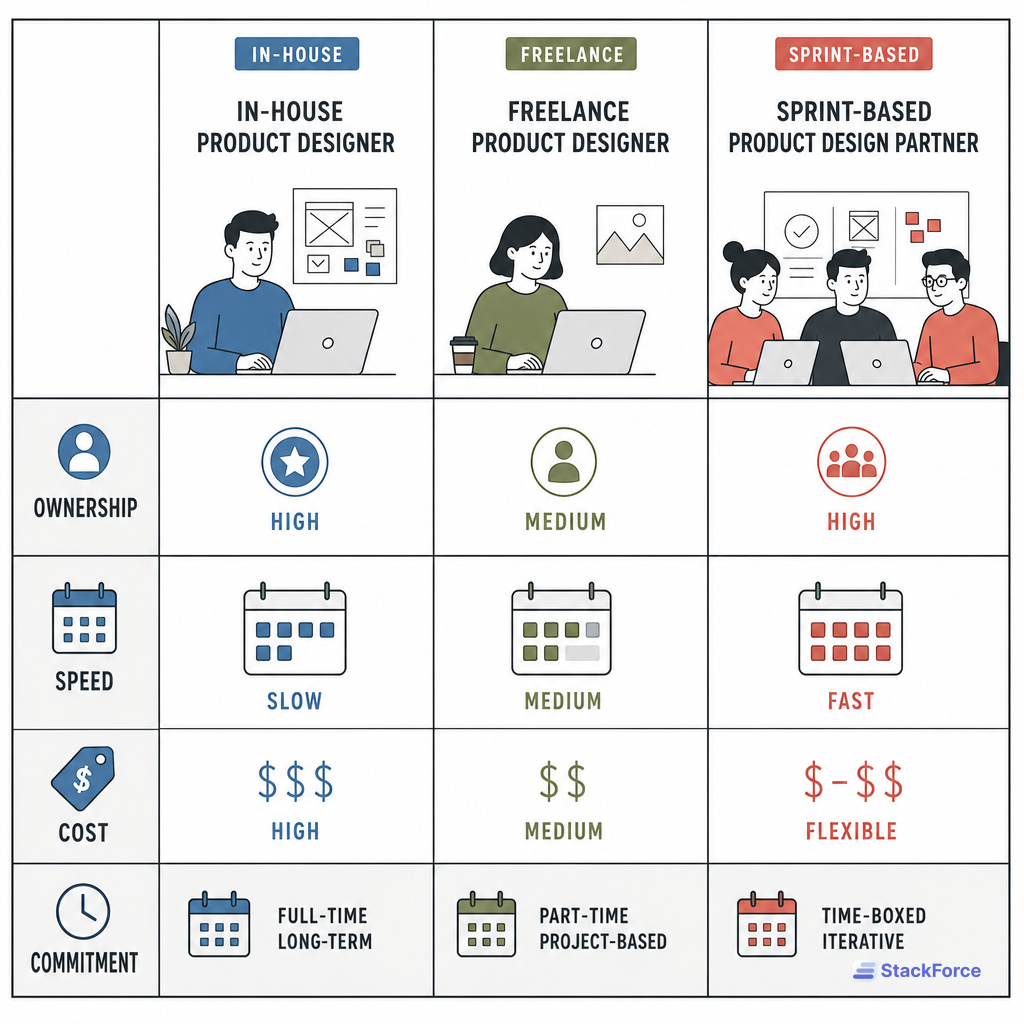
The fastest way to compare the three hiring models at a glance.
How to hire product designers?
The hiring process should start with role clarity, then move through sourcing, portfolio review, interviews, and a realistic design task. Teams that skip the scope step usually end up screening for the wrong thing, especially when the role mixes UX design, UI design, and product strategy.
- Define the role in plain language.
State whether you need someone focused on discovery, interaction design, design systems, or execution speed. A product designer for a SaaS admin product is not the same as a designer for a consumer checkout flow.
- Write a brief that names the product problem.
Include the product area, success metric, collaboration style, and the level of ownership. If you are hiring in India, say whether the role is remote, hybrid, or tied to a specific timezone overlap.
- Source candidates from places where product designers actually show work.
Referrals help, but so do portfolios, design communities, and hiring platforms. Treat a strong design portfolio as a signal of work quality, not as a final answer. If you need a practical baseline for applicant quality, a resume format guide can help you spot whether a candidate knows how to present structured, outcome-led work.
- Screen for evidence, not adjectives.
The best candidates can explain how they used Figma, what changed after user feedback, and why they made a particular trade-off. If the story is mostly about taste, the signal is weak.
- Run a structured interview loop.
Ask the same core questions across candidates. That gives you a clean comparison and avoids hiring the person who interviews best rather than the person who solves the problem best.
- Use a small, realistic exercise.
Give a constrained brief, a short timeline, and a clear output. A good task shows how the designer thinks through ambiguity, not whether they can stay up late polishing mockups.
- Close with a clean offer and onboarding plan.
Tell the candidate what the first 30 days look like, who owns decisions, and what success means. That matters in India as much as anywhere else because the strongest candidates move quickly.
Tip: Use one scorecard for every final-round candidate. Rate problem framing, UX reasoning, UI craft, Figma fluency, collaboration, and product judgment on the same scale.
The keyword hire a product designer shows up in so many marketplace pages because companies want a quick transaction. Your process should be the opposite. You are not buying output volume. You are setting up a role that can shape the product.
What should a product designer role scope include?
A strong scope names the product problem, the seniority, and the kind of design ownership the person will carry. If you want product designer hiring to work in India, the job description has to separate delivery work from strategy work and make the trade-offs visible.
Start with the outcome. Say whether the designer will improve onboarding, increase trial conversion, reduce support tickets, or rebuild a design system. Then state whether the role sits closer to UX design research, UI design polish, or end-to-end product decision-making.
Be specific about the work environment too. Indian candidates want to know if they will be working with founders directly, whether engineering ships weekly, and how much asynchronous communication the team expects. That detail helps serious applicants self-select.
A useful scope also prevents the common mistake of hiring a visual designer when the business really needs a product thinker. If the role is mostly about screenshots, motion, or branded assets, say so honestly. If it is about flows, edge cases, and experimentation, say that instead.
A simple scope template looks like this:
- Product area: onboarding, billing, analytics, or mobile growth.
- Primary responsibility: UX design, UI design, design systems, or mixed product ownership.
- Seniority: junior, mid-level, senior, or lead.
- Collaboration model: with PM, engineering, research, or founders.
- Success metric: activation, retention, task completion, or fewer design reworks.
That one page does more for hiring quality than a glossy job post ever will.
How do you evaluate a product designer portfolio?
A good portfolio proves product judgment, not just visual taste. If the candidate cannot explain what changed, why it changed, and how the team measured the result, the work is probably prettier than it is useful.
Look first for the problem statement. The best case studies show the starting point, the constraint, the option set, and the decision made. A designer who can walk you through a messy flow in Figma, then explain the trade-off behind the final UI, is usually much stronger than someone who only shows final screens.
Check for evidence of iteration. You want to see sketches, prototypes, version changes, or user feedback that altered the design direction. That is where design thinking becomes visible in practice.
Also inspect the portfolio for collaboration signals. Did the designer work with engineering on implementation details? Did they adjust layouts for responsive states? Did they build or extend a design system rather than inventing new patterns every time?
A practical portfolio review checklist:
- Is the problem clearly framed?
- Are the constraints named?
- Does the designer explain the trade-offs?
- Is there evidence of Figma prototypes or artifacts?
- Do the outcomes connect to product metrics or user behaviour?
- Does the work show consistency across UX design and UI design?
Example: If a candidate redesigned a checkout flow, ask what happened to drop-off after the redesign. Even a rough answer like “step-two abandonment fell from 34% to 27% over six weeks” is more useful than “the flow looked cleaner.”
When a portfolio is thin on outcomes, ask for the story behind one screen. Strong designers can usually reconstruct the decisions. Weak ones tend to retreat into visuals.
What interview questions should you ask?
The best interview questions expose how the designer thinks under constraints. You are trying to learn whether the candidate can collaborate, handle ambiguity, and make product decisions that survive engineering reality.
Use questions that force a worked answer, not a slogan. For example, ask how they would improve an onboarding flow with a 20% drop-off rate, or how they would resolve conflict when a founder wants one thing and analytics points to another. That reveals whether the candidate can operate in a startup or SaaS environment without freezing.
A focused interview loop can cover four layers:
- Problem framing.
Ask how they would define the real design problem before touching the UI.
- Craft and reasoning.
Ask them to explain why one layout beats another, not just which one looks better.
- Collaboration.
Ask how they work with product managers and engineers when timelines slip.
- Execution.
Ask what they do when a design system already exists and the new feature does not fit neatly inside it.
Good questions include:
- Walk us through a product design decision you changed after user feedback.
- What does your Figma file look like when engineering is about to pick it up?
- How do you balance UX design with UI design when time is tight?
- Tell us about a time product requirements were vague. How did you narrow the problem?
- What is the last design system constraint you had to work around?
Keep the rubric consistent. If one candidate gets grilled on systems thinking and another gets asked only about aesthetic choices, the comparison is already broken.
How much does it cost to hire a product designer?
Cost depends on seniority, hiring model, and how much ownership you expect. In India, the cheapest path is rarely the lowest-cost path once you account for hiring time, onboarding, revisions, and the cost of waiting for a bad fit.
| Hiring model | Typical cost shape | Best use case | Hidden cost |
|---|---|---|---|
| Junior in-house product designer | Lower salary, higher management overhead | Support work and simpler execution | Slower output and more supervision |
| Mid-level in-house product designer | Balanced salary and ownership | Core product work | Recruiting time if the market is tight |
| Senior in-house product designer | Higher salary, stronger judgment | High-stakes UX design and product strategy | Longer search and stronger compensation expectations |
| Freelance product designer | Day rate or project fee | Defined, short projects | Context ramp and possible rework |
| Sprint-based product design partner | Fixed fee per sprint or phase | MVPs, redesigns, and urgent experiments | Needs a well-scoped brief |
The big budget mistake is treating the designer as a screen production resource. A senior product designer often saves money by reducing back-and-forth, improving flow quality, and cutting rework between product and engineering.
If you are evaluating cost to hire a product designer, budget for more than compensation. Add recruiting time, design tool access such as Figma, onboarding, and the internal time required to review work. Those costs matter most in small teams where every extra week affects roadmap delivery. If you are writing the role from scratch, the complete guide to ATS resume screening in India is a useful reminder that your hiring workflow should filter for signal, not just keywords.
A simple rule helps:
- Use in-house hiring when the design workload is constant.
- Use freelance help when the brief is narrow and the timeline is short.
- Use a sprint-based partner when the problem is urgent, discrete, and outcome-driven.
For product teams in India, that rule is usually more useful than chasing a generic market rate.
Why do companies hire product designers?
Companies hire product designers to turn product ideas into usable experiences that ship faster and perform better. The role is not about decoration. It is about reducing friction between intent, interface, and execution.
Strong product designers improve activation, retention, and conversion by making flows clearer and more resilient. They also reduce design debt by building patterns that can scale across the product rather than reinventing every screen from scratch.
This is why product designer hiring matters especially in SaaS and product-led companies. When the product is the business, design quality affects onboarding, self-serve conversion, support load, and how quickly engineering can ship without breaking the experience.
A good designer also helps teams avoid the common trap of confusing graphic design with product design. Graphic design services are about visual communication. Product design is about how users complete tasks inside a product. Both matter, but they solve different problems.
If your team is still deciding whether the role is necessary, ask a simple question: are you trying to make a product look better, or are you trying to make it work better? The answer usually makes the hire obvious.
What should you avoid when hiring in India?
The biggest hiring mistakes are easy to spot and expensive to fix. If you hire for visuals alone, skip portfolio depth, or confuse product design with graphic design, you will probably end up with pretty work and weak product outcomes.
Warning: Do not use a generic job post that says “designer wanted” and hope the right people self-sort. In India, strong candidates are often evaluating your brief as hard as you are evaluating them.
Avoid these traps:
- Hiring on taste instead of product judgment.
- Treating Figma fluency as the whole job.
- Ignoring design thinking and problem framing.
- Assuming a great graphic designer will automatically be a great product designer.
- Rushing the process and losing stronger candidates to faster teams.
Time-to-hire matters more than many teams expect. The best product designers in India often have multiple options, especially if they have worked with startup or SaaS teams before. If your process drags, the market moves on.
The fix is not more interviews. It is a tighter brief, a clearer rubric, and a decision process that respects the candidate’s time.
When should you hire a sprint-based product design partner?
A sprint-based product design partner makes sense when the problem is defined, the timeline is short, and you want focused output without adding permanent headcount. This model works well for MVPs, redesigns, and product experiments where speed matters more than long-term ownership.
It also fits teams that already have product and engineering bandwidth but need design throughput right now. If the internal team knows what needs to ship but cannot spare the cycles to explore, prototype, and refine the experience, a sprint partner can unblock the work.
The cleanest use cases are:
- A new onboarding flow that needs to launch in weeks, not months.
- A dashboard redesign that requires structure, not just visual polish.
- A conversion experiment with a narrow success metric.
- A product area that needs one strong design push before engineering execution.
This model is different from freelance graphic design because the goal is not just visual delivery. It is product outcome. It also differs from ongoing product designer hiring because you are buying a phase of work, not a permanent role.
If you need one design decision, one prototype, and one launch-ready direction, a sprint-based partner is usually the cleanest option. If you need weekly ownership across multiple product surfaces, hire in-house instead.
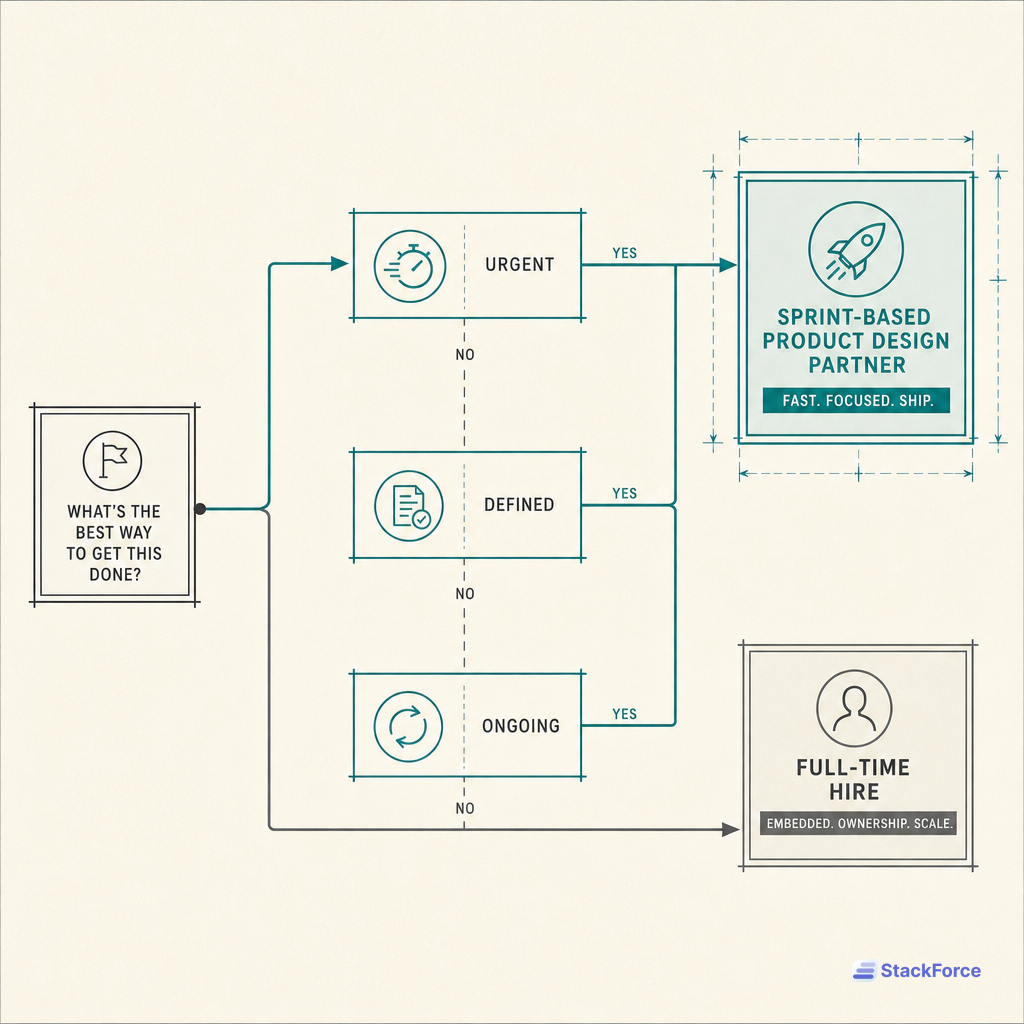
Use the decision tree when the scope is clear but the timeline is tight.
Frequently asked questions
How to hire a product designer?
Hire a product designer by defining the product problem first, then screening for portfolio evidence, Figma fluency, product thinking, and collaboration skills. The most reliable process is role scope, shortlist, portfolio review, structured interviews, and a small design exercise.
How to hire product designers?
Hire product designers the same way you would build any core function: separate the roles, define the outcomes, and use one rubric for every candidate. If you are hiring multiple people, compare them by level and specialisation, not by who looks best in a single case study.
How to hire a sprint-based product design partner?
Hire a sprint-based product design partner by scoping one clear product problem, setting a delivery window, and agreeing on success metrics before work begins. The best partners show how they will move from ambiguity to a prototype or shipped direction inside a short sprint.
How much does it cost to hire a product designer?
The cost to hire a product designer in India varies by seniority and hiring model, with full-time, freelance, and sprint-based engagements landing in very different budget bands. The real cost also includes recruiting time, onboarding, and the design tools and review cycles needed to get the work into production.
If you want a cleaner hiring process, start with the model that fits your roadmap, then write the brief around the outcome you actually need. That one decision makes the rest of the search easier, faster, and much less noisy.