
Hire Software Developers in India: 2026 Guide
As of June 2026, the fastest way to hire software developers in India is to choose the right hiring model first, then screen for shipping ability instead of résumé polish. India gives you broad access to strong engineers, but the best outcome depends on whether you need direct hires, offshore hiring, a dedicated development team, or a software development company.
Key takeaways
- India is a strong hiring market when you need speed, cost efficiency, and access to a deep technical pool.
- The right model depends on how much control, management bandwidth, and delivery risk you want to keep in-house.
- A structured hiring flow should test shipped work, communication, and overlap with your team before you make an offer.
- The most expensive mistake is choosing the cheapest option without checking ownership, reliability, and retention.
Should you hire software developers in India?
Yes, if you want access to a large talent pool, reasonable cost leverage, and developers who can work well in product teams. India is a strong fit for startups, SaaS companies, and teams that need to hire software developers without waiting months for local market supply to loosen. It is less attractive if you need everyone in the same office, or if your team cannot manage across time zones.
The cleanest way to decide is to compare four options: direct hire, offshore hiring, a dedicated development team, and a software development company. Direct hire gives you the most control. Offshore hiring gives you flexibility and lower fixed cost. A dedicated development team gives you stable capacity without building every role internally. A software development company gives you a delivery partner, which reduces management load but usually costs more than a single hire.
The right answer also depends on the work itself. A new product bet with changing scope usually needs a different setup from a mature SaaS platform where the team already knows the domain. If your founders and senior engineers are stretched thin, the model with the lowest coordination cost often wins, even when the hourly rate looks higher.
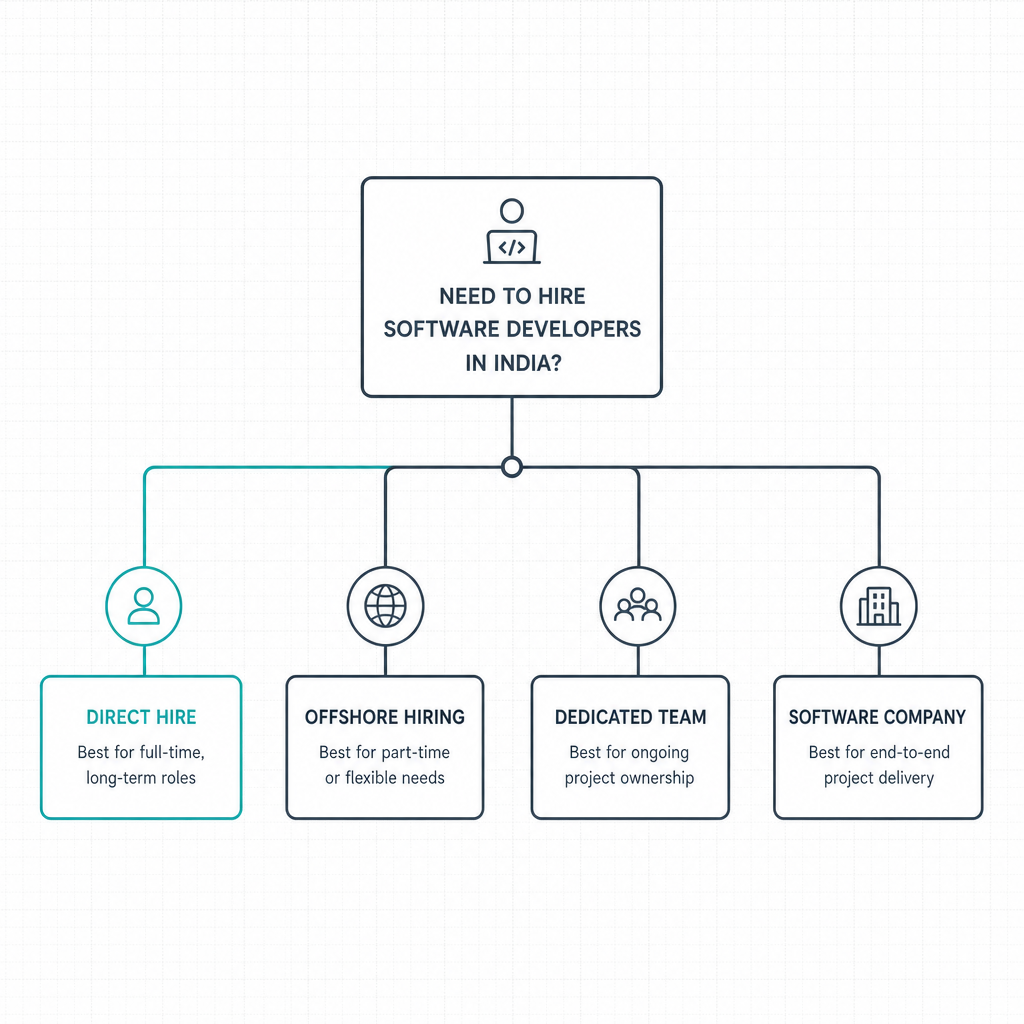
A quick way to choose the right hiring model before you start sourcing.
What hiring model fits your situation?
The best hiring model is the one that matches your control needs, speed target, and internal management capacity. If you want to compare options properly, use the table below instead of starting with a vendor pitch deck or a marketplace profile.
| Model | Best for | What you control | Main tradeoff |
|---|---|---|---|
| Direct hire | Teams that want long-term ownership | Role, culture, roadmap fit | Slowest to source and close |
| Offshore hiring | Founders who want access to India-based talent with more flexibility | Talent selection and process design | Coordination can get messy if you are not structured |
| Dedicated development team | Product teams that need stable capacity | Priority, sprint cadence, and team rituals | Less nimble than a single hire for quick changes |
| Software development company | Companies that want a delivery partner and lower management load | Scope and acceptance criteria | Less day-to-day control than in-house hiring |
For startup teams, direct hire usually makes sense when the role is central to the product and you want the person to grow with the company. For SaaS teams, offshore hiring and dedicated development team models work well when you already have product direction and need execution capacity. For FAANG-style hiring pipelines, direct hire remains the default because the interview loop, scorecards, and ownership expectations are tightly defined.
A software development company is worth considering when you need a broader build-out, not just one engineer. The tradeoff is simple: you trade some flexibility and granular control for a more managed delivery layer. That can be a good deal if your internal team is small and your product scope is clear.
How do you hire software developers in India?
You hire software developers in India by defining the role tightly, sourcing from the right channels, and testing for real delivery ability before the offer. The most common mistake is to start with a generic job description and hope the market does the sorting for you.
- Define the role by stack, seniority, scope, and whether the work is full-time, contract, offshore, or embedded into a team.
- Write down the outcomes you expect in the first 90 days. For example: ship onboarding changes, reduce API latency, or own a checkout flow.
- Source from referrals, hiring platforms, recruiters, and software development companies. Keep the first pass short so you do not drown in profiles.
- Screen for communication, availability overlap, and evidence of shipped work.
- Run technical interviews that include code quality, system design, and product thinking.
- Check references before you close, especially for senior roles or vendor-led hires.
- Make the offer with a clear start date, reporting line, and delivery expectation.
The screening flow should not be only about ATS screening, even if your pipeline starts there. ATS screening helps you sort resumes quickly, but it cannot tell you whether someone can debug production issues or make tradeoffs in a messy product environment. Use the résumé as a filter, then validate with a structured interview and a practical task.
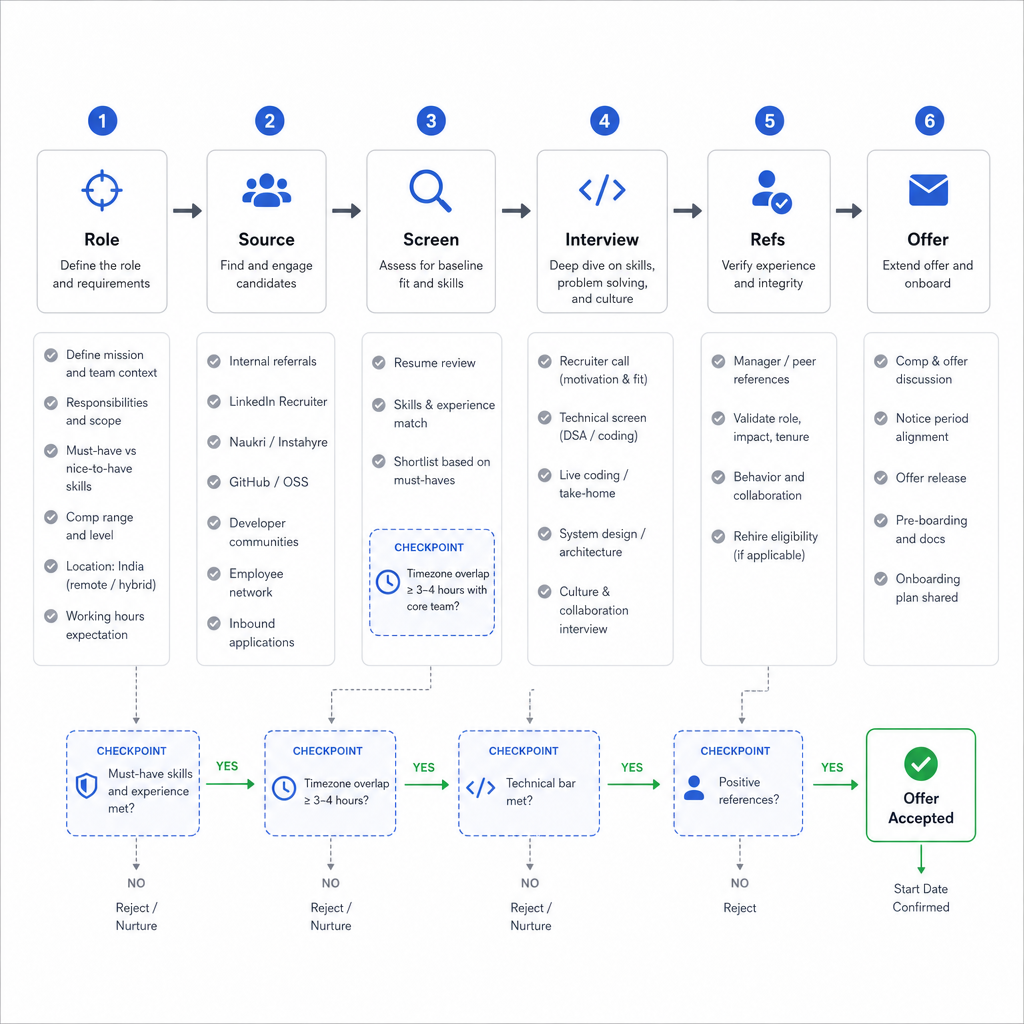
Use this flow to keep the hiring sequence structured.
A strong India hiring process also checks timezone overlap early. If your team works in New York or San Francisco, you need at least a few shared hours for reviews, standups, and unblock calls. That detail sounds small until it becomes the reason a strong candidate drops out or a vendor team starts slipping.
How to hire a software development company
A software development company should be judged on delivery proof, not presentation quality. The strongest vendor will show you relevant projects, a clear delivery process, and the exact people who will work on your product.
Start with evidence. Ask for recent case studies in your domain or adjacent domains, not a generic list of logos. If you are building an internal tool, a consumer app agency case study is less useful than a team that has shipped workflow-heavy products with similar complexity. If you are building for a startup or SaaS audience, ask how they handle changing scope and product feedback loops.
Then inspect the team itself. Who owns the account? Who leads engineering? Who writes the code? A polished sales deck can hide a weak bench, and a weak bench is where timelines slip. You want stable staffing, transparent pricing, and a real escalation path if a key engineer leaves.
Warning: If a vendor cannot explain its delivery process in plain English, assume the handoff will be harder than the proposal suggests.
A good software development company should be able to answer three questions cleanly:
- What happens in week one?
- How do scope changes get approved?
- How do you report blockers and quality issues?
If the answers are vague, you are not buying delivery. You are buying risk.
How to hire dedicated software development team
A dedicated development team makes sense when you want stable engineering capacity without adding every role to payroll. This model works well when your roadmap is steady, your product is already defined, and you want a team that can learn your codebase deeply over time.
The main thing to clarify is ownership. The team needs a single decision-maker on your side, a clear sprint cadence, and a clean answer to who prioritises work when the backlog grows. If nobody owns delivery from your side, the team can become busy without becoming useful.
A dedicated team should also fit into your operating rhythm. That means the same tools, the same issue tracker, the same review standards, and the same security expectations. If you are running product reviews in Linear and code review in GitHub, the vendor team should already be comfortable in that workflow.
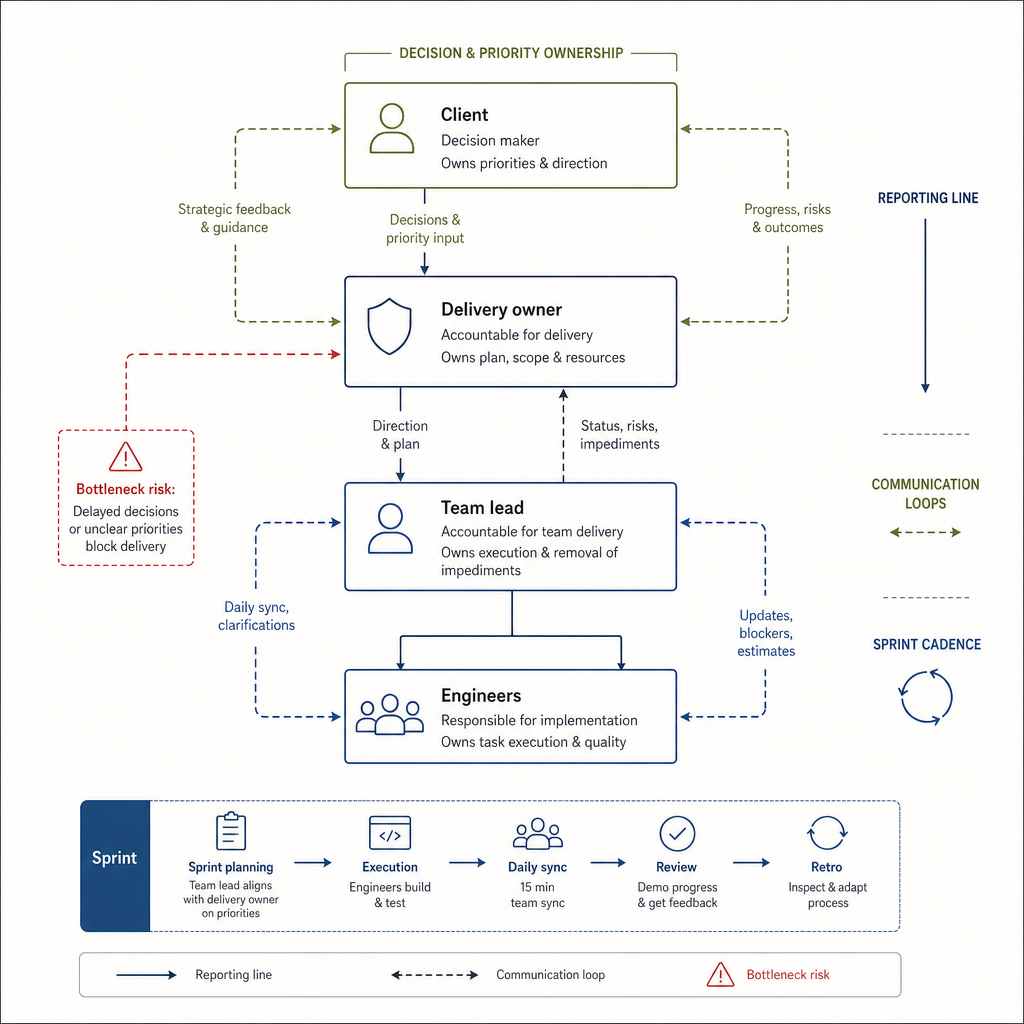
Clear ownership is what makes a dedicated team work.
Watch for hidden friction around knowledge transfer and attrition. If the vendor keeps one person as the unofficial bottleneck, you lose the point of the model. The safer setup is a team with documented context, shared code ownership, and enough overlap that one departure does not stall the project.
How much does it cost to hire a software developer?
The cost to hire a software developer in India depends on seniority, specialization, employment model, and the amount of management overhead you absorb. A junior engineer, a senior backend developer, and a specialist in distributed systems will not price the same way, even if they all look good on paper.
As a practical market check, team hiring discussions in 2026 often reference India’s large engineering supply base and the continued strength of its software services sector, which is one reason demand stays competitive for experienced developers.
| Cost driver | Lower-cost setup | Higher-cost setup |
|---|---|---|
| Seniority | Junior or mid-level | Staff, lead, or specialist |
| Hiring model | Direct hire or simple offshore engagement | Software development company or premium dedicated team |
| Speed | Longer hiring cycle | Faster start with a vendor or retained search |
| Management overhead | High internal coordination | Lower internal coordination |
| Risk profile | More variance in delivery | More process and accountability |
The headline number only tells part of the story. You also pay for sourcing time, onboarding, equipment, review cycles, and the cost of your own team managing the hire. Offshore hiring can lower salary spend, but it can add coordination cost if the process is loose. A cheaper developer who misses deadlines is more expensive than a stronger one who ships.
For founders, the useful question is not “What is the cheapest developer?” It is “What is the lowest total cost way to get this work shipped on time?” That frame usually leads to better decisions because it includes quality, speed, and retention instead of only payroll.
How to screen for quality beyond the CV
The strongest screening process checks evidence of shipped work, not just a clean résumé. That matters even more in FAANG-style hiring pipelines, where candidates often know how to present well but still need to prove depth under pressure.
Use a simple checklist:
- [ ] Can the candidate explain a project they personally shipped?
- [ ] Do they describe tradeoffs clearly, or only list tools?
- [ ] Can they debug a broken feature without hand-holding?
- [ ] Do they show product judgment, not just code volume?
- [ ] Can they communicate clearly across written and live formats?
- [ ] Do they have enough overlap with your team’s working hours?
A practical interview loop is better than a long, vague one. One round should cover coding or architecture. Another should test product thinking and collaboration. A final round should verify references and consistency. That structure is useful whether you are doing direct hire, offshore hiring, or choosing between multiple vendors.
ATS screening still has a place here. It helps you process volume and remove obvious mismatches early, especially if you are hiring under time pressure. But ATS screening should never be the gate that decides technical quality by itself. The shortlist is where your actual hiring judgment starts.
What are the common hiring mistakes to avoid?
The biggest hiring mistakes come from optimising for price, speed, or polish while ignoring the way the work will actually get done. The most common failure mode is hiring too cheaply, then spending the next six months paying for rework, missed deadlines, and poor communication.
Another mistake is treating every model the same. A software development company is not a direct hire. A dedicated development team is not a freelancer pool. Offshore hiring is not a shortcut that removes management work. Each model changes how you should evaluate candidates, set expectations, and measure performance.
Tip: Write the scope, success metrics, and communication rules before you start interviewing. That single document makes offshore hiring and vendor selection far less chaotic.
Do not skip reference checks, especially for senior hires. Do not assume a famous company name guarantees execution in your environment. And do not confuse interview confidence with delivery ability. The best hires are usually the ones who can explain exactly how they shipped something hard.
What should you do next?
Choose the model that matches your budget, urgency, and internal bandwidth, then run a structured process from the start. If you need control and long-term ownership, start with direct hire. If you need flexibility, compare offshore hiring, a dedicated development team, and a software development company against your actual management capacity.
If you are still unsure, write a one-page role brief, define the first 90 days, and build a scorecard before you source. That will do more for your hiring outcomes than another week of browsing marketplace listings.
Frequently asked questions
How to hire offshore software developers?
You hire offshore software developers by treating the process like a structured collaboration problem, not a cheap labour search. Start with role scope, time overlap, and the communication standard you expect, then screen for proof of shipped work and responsiveness. Offshore hiring works best when your team can give clear priorities and review work consistently.
How to hire a software development company?
You hire a software development company by checking delivery evidence, team composition, and the exact process they use to move from scope to release. Ask for case studies, the names and roles of the people assigned to your project, and an explanation of how change requests get handled. If the answers stay vague, keep looking.
How to hire dedicated software development team?
You hire a dedicated development team by locking down ownership, reporting lines, cadence, and knowledge transfer before the engagement starts. This model works when you want long-term capacity without building every function in-house, but it only works if someone on your side owns delivery and the vendor team can integrate into your workflow.