One Page Resume vs Two Page Resume: A Clear Rule
For most tech applicants, the right one page resume is the one that fits your strongest proof without squeezing out impact. Early-career candidates usually win with one page; mid-career and senior candidates can use two pages when the second page adds real signal. For product companies, startups, SaaS hiring, and FAANG-style pipelines, clarity beats page-count ideology.
The short answer
Use one page if you can fit relevant experience, metrics, and recent impact cleanly. Use two pages if cutting to one page means losing meaningful work experience.
The rule is simple: optimize for signal density, not for a number.
Decision rule: One page is the default for early-career tech candidates; two pages are justified when extra space preserves relevant proof.
Should a resume be one page?
- Yes, when the page is dense. If your resume can show role fit, strong outcomes, and clean formatting without filler, one page is the sharper choice.
- Yes, especially for early-career candidates. New grads, early product managers, and career switchers with focused experience usually benefit from a tighter resume format.
- No, if important proof gets cut. If a second page preserves recent impact, leadership, or domain depth, that extra space helps recruiter screening instead of hurting it.
- Yes, if ATS still reads it cleanly. A one-page layout only works when the structure stays readable, keyword-relevant, and easy to scan.
A good test is whether each line earns its place. If the answer is no, shorten the content. If the answer is yes but the page is still cramped, you may need two pages.
Should resumes be one page?
The broader rule is less rigid than people make it sound. Should resumes be one page? Not by default for everyone, and not because hiring teams are counting paper like it is 2009. The better question is whether your strongest recent experience can fit without damage.
For startup hiring and SaaS hiring, concise resumes often do well because reviewers move fast and care about immediate relevance. That does not mean every successful resume must be one page. It means the best version is usually the shortest version that still shows enough evidence.
Tip: If you have to choose between a thinner story and a second page, keep the story and expand the page count.
Does a resume have to be one page?
No. Does a resume have to be one page? Only if one page still lets you show the right depth.
A two page resume is often the better move for candidates with:
- several relevant roles with measurable impact
- leadership scope that matters to the next role
- enough recent work experience to prove readiness
- domain-specific projects that would look truncated if compressed too hard
For FAANG-style pipelines, the real filter is not page count. It is whether the resume makes the candidate easy to evaluate. If a second page adds the evidence a recruiter or hiring manager needs, it is doing its job.
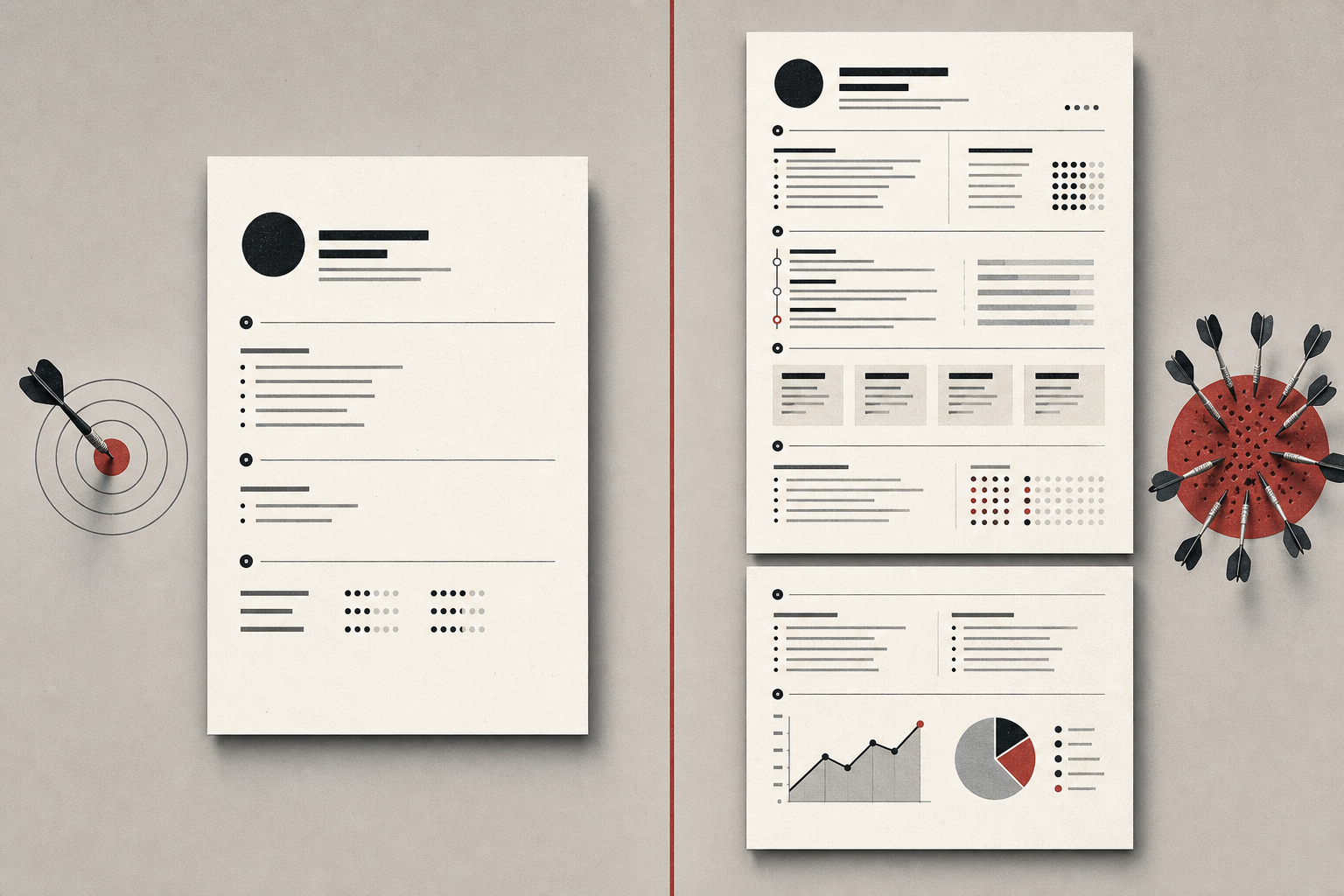
One page resume vs two page resume
| Criterion | One page resume | Two page resume |
|---|---|---|
| Best for | Early-career candidates, tight role fit, fast scans | Mid-career and senior candidates with deeper relevant history |
| ATS friendliness | Strong when formatting is simple | Strong when structure stays clean |
| Recruiter screening | Faster to scan | Better when the first page is strong and the second adds proof |
| Risk | Cutting useful context | Adding filler or weak bullets |
| Best use case | Focused, high-signal profile | Dense experience that would be damaged by compression |
The comparison is not about aesthetics. It is about whether the resume tells the right story in the fewest possible words. A one-page resume wins when it keeps the signal sharp; a two-page resume wins when it preserves the signal that matters.
How to choose the right length by experience level
- Choose one page if you are early-career. If your experience is mostly internships, one strong project, or a few relevant roles, a one page resume is usually enough.
- Move to two pages if you are mid-career and your recent impact is substantial. A second page makes sense when it lets you keep recent wins, scope, and measurable outcomes intact.
- Use two pages if you are senior and the history is relevant. Senior candidates should not cut credible depth just to force everything onto one page.
- Decide by role fit, not by habit. A resume for product companies should emphasize product thinking, ownership, and outcomes, whether that fits on one page or two.
- Review the second page with a hard edit. If it only repeats what the first page already says, cut it. If it adds proof, keep it.
Quick filter: If cutting a section removes proof, keep it; if it removes nothing new, cut it.
A practical rule: if you can cut a section and the reader learns nothing new, it should go. If cutting it removes proof of impact, keep it and let the resume run long.
What to cut when you need to stay on one page
- [x] Remove old roles that no longer support the target job.
- [x] Cut duplicate bullets that restate the same achievement.
- [x] Trim low-signal duties that read like a job description.
- [x] Keep metrics, scope, and outcomes.
- [x] Keep keywords that match the role without stuffing them.
- [x] Preserve the most relevant resume builder output only if it helps structure, not if it adds noise.
- [x] Avoid decorative resume templates that waste space.
If you are using a builder, treat it like a layout tool, not a content strategy. The best one-page version is usually the one with fewer sections, stronger bullets, and cleaner spacing. That is especially true when you are trying to stay ATS-friendly without turning the page into a wall of text.
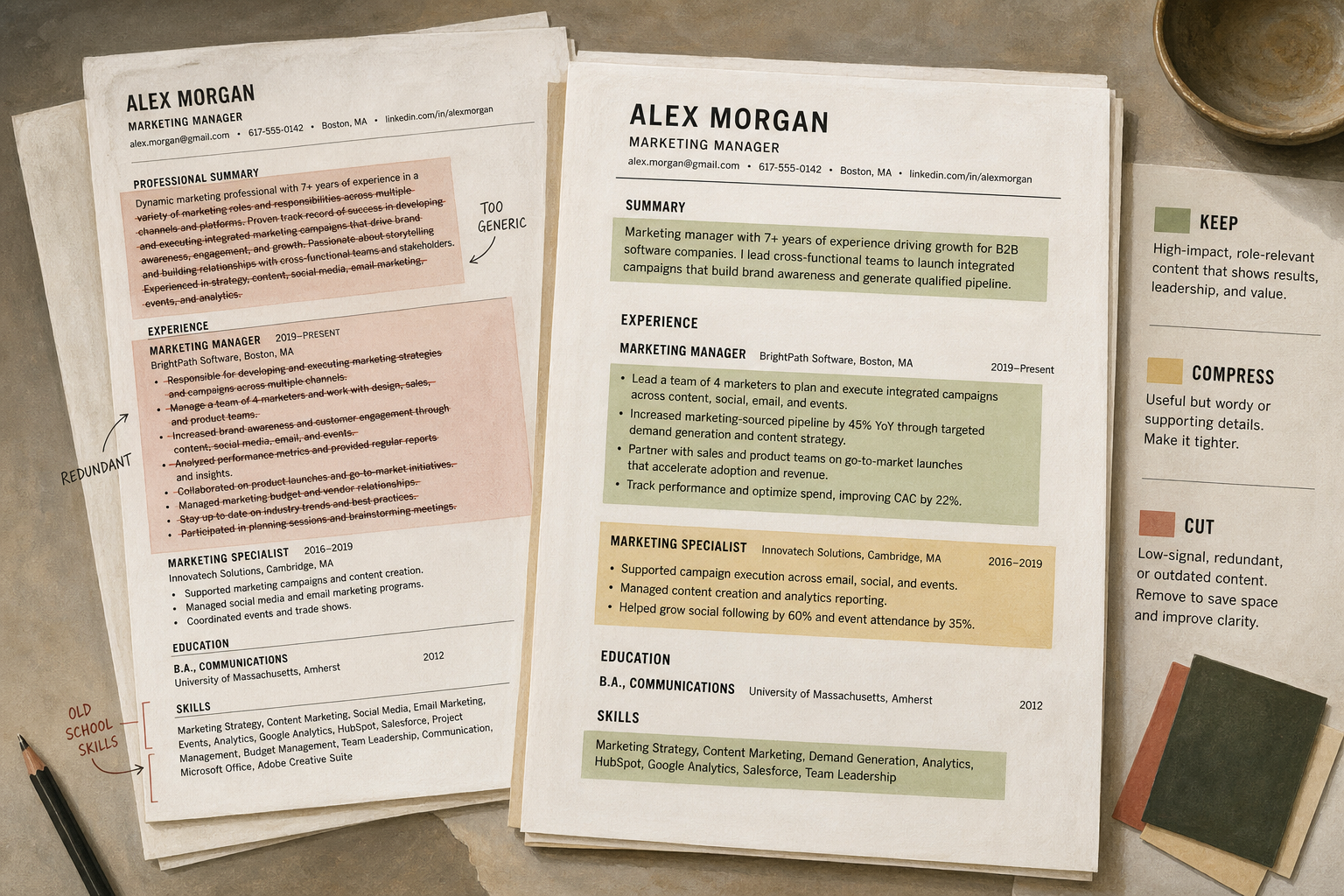
Cut low-signal content first, then preserve the bullets that prove impact.
When two pages are the better choice
Two pages make sense when the second page carries real weight. That usually means recent leadership, product launches, technical depth, or measurable outcomes that would be weakened by aggressive compression.
A second page is also justified when you have enough relevant history that a one-page version starts to feel selective in a bad way. In that case, the issue is not length. The issue is whether the shorter version makes you look less capable than you are.
For candidates targeting FAANG, product companies, or high-growth SaaS roles, the strongest resumes often read like a compressed proof deck. If the extra page helps the reviewer understand scale, ownership, and progression, it earns its place.
Use two pages when: the added space introduces new proof, not repeated bullets.
Which resume length works best for product companies, startups, SaaS companies, and FAANG-style hiring pipelines?
- Startup hiring: one page is often the best default because reviewers scan fast and reward clarity.
- SaaS hiring: either length can work if the story is tight and the impact is quantified.
- FAANG-style hiring: two pages can work when the experience is dense, relevant, and easy to scan.
- Product companies: choose the format that shows ownership, outcomes, and role fit with the least friction.
In practice, the hiring context changes how much room you need. Startup hiring tends to favor speed and focus. SaaS hiring tends to reward precision and measurable results. FAANG-style review flows can support more depth, but only if every line still earns attention.
For this audience, the winning move is not chasing a universal rule. It is matching the length to the amount of proof you actually have.
Should my resume be one page?
Yes, if you can fit your strongest evidence on one page without losing the plot. For many early-career candidates, that is the cleanest answer. The page is short, but the story is obvious.
Should resume be one page?
Usually, but not as a law. If a second page helps preserve relevant experience and improves clarity, use it. If it only adds padding, stay on one page.
Should your resume be one page?
Only if one page still shows enough to pass recruiter screening. If the role is senior, technical, or highly specialized, the better question is whether the resume is complete enough to be useful.
The safest next step is to compare your current draft against this rule: keep the shortest version that still proves you can do the job. If you are trimming for space, cut weak bullets first, not strong evidence.