Resume Trends 2026: What Tech Hiring Rewards Now
In 2026, the resume trends that matter most are the ones that make your experience easier to trust fast. For product, startup, SaaS, and FAANG-style roles, that means a clean, ATS-friendly resume, sharp impact bullets, and proof that you can ship outcomes instead of just list duties.
What are the current resume trends in 2026?
The short version: resume trends 2026 favor cleaner formatting, stronger proof, and faster scans from recruiters and ATS. Hiring teams want a resume that parses cleanly, reads in seconds, and makes your impact obvious without extra decoding.
That shift shows up in three places. Formatting is getting simpler, not louder. Bullets are getting more quantified and role-specific. Candidates are using sections like skills and projects more deliberately, especially when those sections help with recruiter screening and applicant tracking systems.
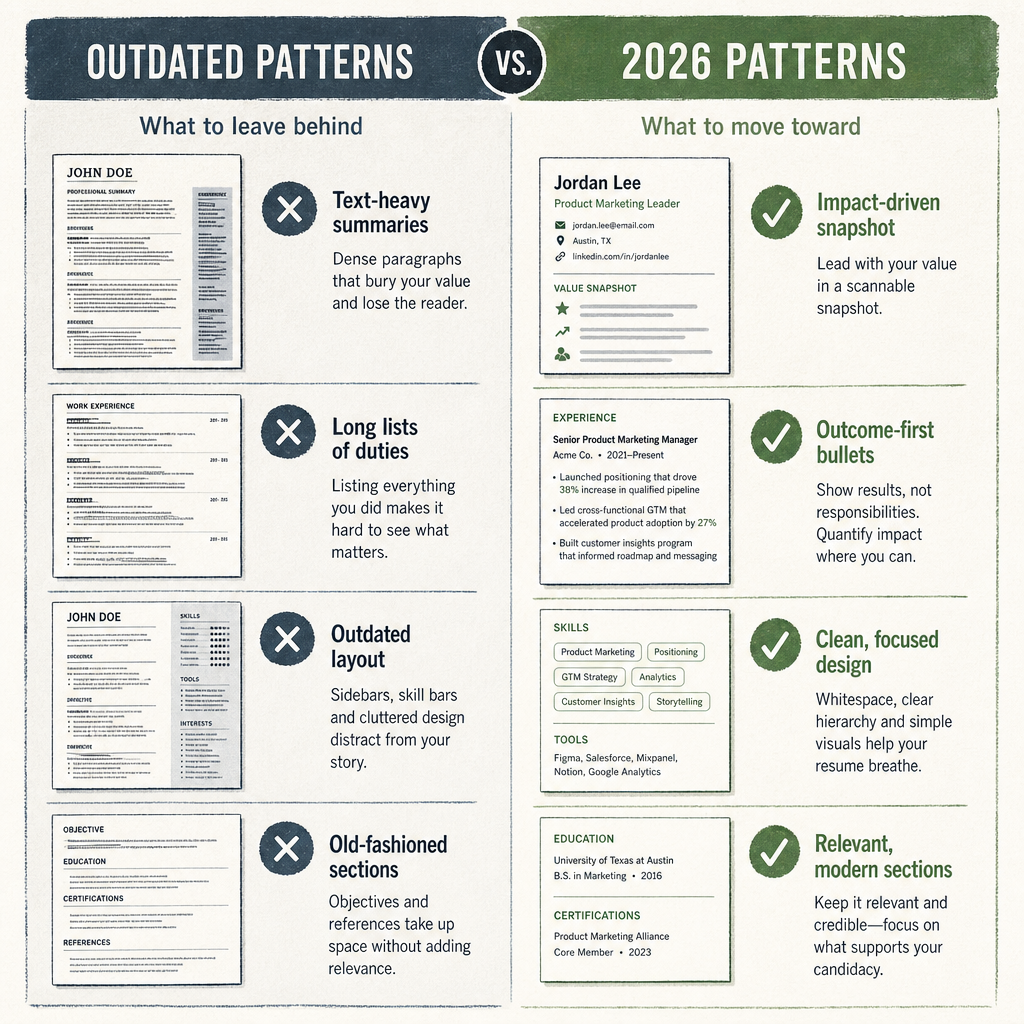
The overview shows the shift from decoration to signal.
Tech hiring teams do not reward decorative layouts, dense corporate prose, or resumes that read like a generic job description. They reward clarity, evidence, and a structure that makes the yes/no call easier.
Tip: If your resume only looks better on your screen than it does in plain text, it is already behind the curve.
What’s in for tech resumes this year?
Current resume trends in 2026 favor content that can survive both ATS parsing and fast human review. The strongest resumes now look closer to a product spec than a brochure: concise summary, clean hierarchy, strong metrics, and the right proof in the right place.
- Concise summary statements that point to your role, scope, and strengths in one tight paragraph.
- Quantified impact bullets that use numbers, percentages, revenue, latency, conversion, retention, or scale.
- Skills sections that map to the job description without turning into a keyword dump.
- Projects sections that help early-career candidates or career switchers show applied work.
- Modern resume format choices like simple headers, clear section labels, and readable spacing.
These are the “in” signals because they help both humans and machines. Recruiters can scan faster. Hiring managers can map your fit faster. ATS tools can parse the content without getting confused by tables, text boxes, or overdesigned columns.
The old Harvard resume format still works as a baseline, but it is not a magic template. It gives you structure; it does not give you relevance. For tech hiring, you still need to adapt it around measurable impact, tooling, product exposure, and a clearer story about what kind of work you do.
A strong 2026 resume usually includes some version of this stack:
| Element | Why it works now | What to include |
|---|---|---|
| Summary | Gives immediate context | Role, domain, years, strongest strengths |
| Skills | Improves scanability | Tools, methods, systems, product areas |
| Experience | Carries the proof | Metrics, scope, outcomes, decisions |
| Projects | Adds evidence | Shipped work, side projects, portfolio links |
| Education | Supports filtering | Degree, school, relevant honours |
What’s out on resumes in 2026?
Resume writing trends have also made some habits look dated fast. The biggest one is clutter. If a resume takes effort to decode, it is working against you.
- Generic objective statements are out. They waste space and say little about fit.
- Overdesigned visuals are out. Fancy graphics often hurt parsing and do not help credibility.
- Responsibility-heavy bullets are out. “Managed,” “supported,” and “worked on” are weaker than outcomes.
- Keyword stuffing is out. It reads artificial to recruiters and can still trip ATS quality checks.
- One-size-fits-all resumes are out. Fast-moving tech teams expect role alignment.
The clearest thing to remove from a resume in 2026 is anything that looks like padding. If a line exists only because older advice said you should have one more bullet, delete it. If a section repeats the job description in softer language, tighten it or cut it.
This is also where LinkedIn changes the expectation. Recruiters often cross-check your resume with your profile, so vague claims stand out faster now. If your resume says one thing and your LinkedIn says another, the mismatch becomes part of the signal.
Is the trend now a one-page resume?
A one-page resume is still the default for many early-career candidates, but it is not a rule that survives every role. The real trend in 2026 is signal density, not page count.
For early-career candidates, one page often works best because it forces prioritization. For product managers, senior engineers, data folks, and other specialized candidates, a second page can be the right move if it carries new information instead of repetition. FAANG reviewers and startup recruiters both care more about whether the resume earns its space than whether it obeys a rigid format rule.
The tradeoff is simple:
| Candidate type | One page works when | Two pages works when |
|---|---|---|
| Early career | You have focused internships, projects, or 1–3 roles | Rarely needed unless experience is unusually dense |
| Mid-level | Your most relevant impact fits cleanly | You have multiple strong roles with distinct scope |
| Senior | Your story is narrow and high-signal | You have leadership, breadth, and measurable outcomes worth keeping |
| Product / SaaS | You can show product thinking quickly | You have multiple launches, growth wins, or cross-functional wins |
A useful test: if the second page only repeats weaker bullets, it is a mistake. If it adds meaningful proof, it earns its place. That is why the best advice is not “one page only”; it is “only keep what strengthens the hiring decision.”
How should you format a modern resume in 2026?
A modern resume format in 2026 should feel almost invisible. The reader should see the content, not the design choices.
- Use a simple header with your name, location, email, LinkedIn, and portfolio if relevant.
- Keep section labels standard: Summary, Experience, Skills, Projects, Education.
- Use one clean font family and consistent sizing.
- Avoid text boxes, columns that break reading order, and decorative icons.
- Keep bullets tight and parallel.
- Export as PDF unless the application explicitly asks for something else.
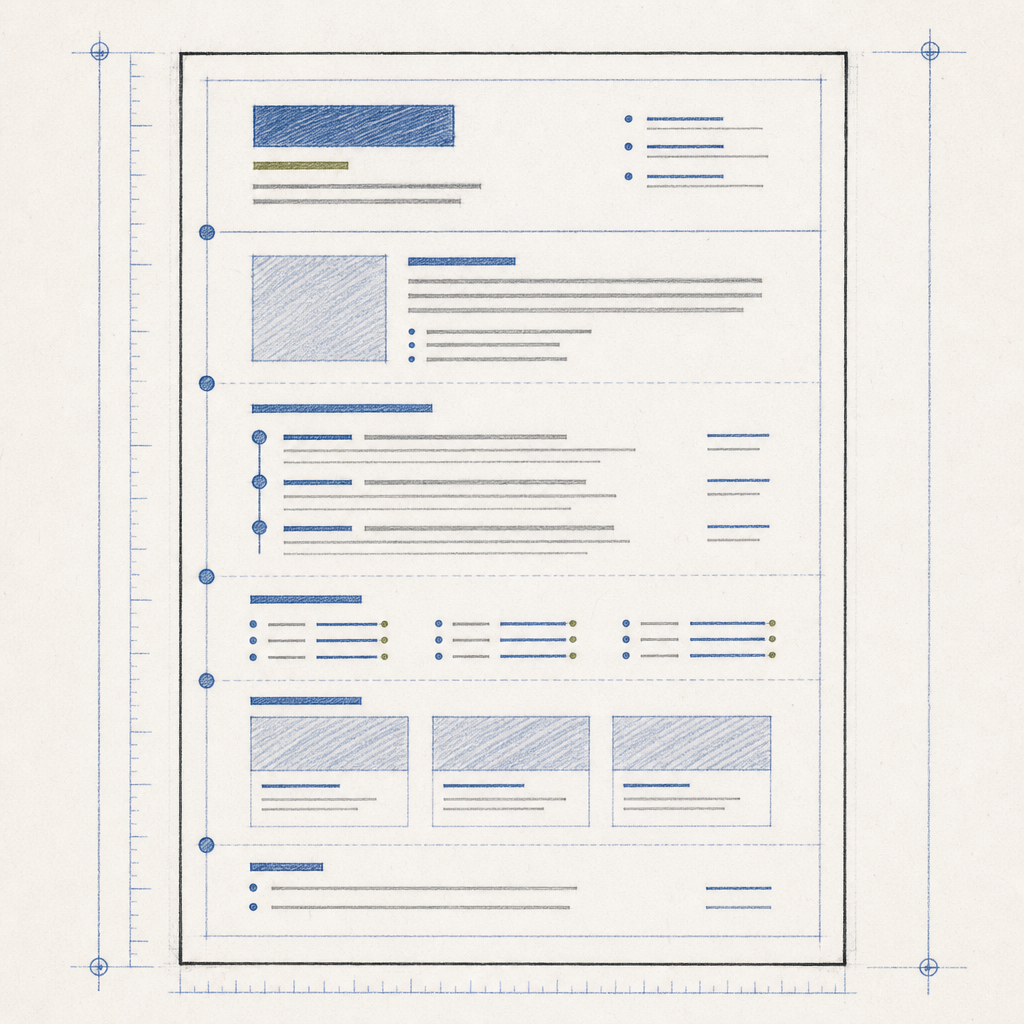
The layout breaks down the format recommended in the article.
Warning: Fancy layout elements can look polished in a editor preview and still fail in applicant tracking systems. If the parsing breaks, the polish does not matter.
This is where ATS-friendly resume trends matter most. ATS tools are not judging taste; they are extracting structure. That means predictable headings, standard dates, and readable text beats any design trick that sacrifices machine readability.
For candidates asking how to write a resume or how to start a resume, the answer in 2026 is still the same at the structural level: lead with the strongest identity, then prove it with the most relevant experience. The difference now is that every section has to do more work.
Why recruiters care more about proof than polish
Recruiter screening has become faster, not more generous. People reviewing resumes are looking for reasons to keep reading, and the first pass is usually about fit, scope, and evidence.
That is why quantified impact now beats visual flourish so decisively. A line that says you improved checkout conversion by 18% or reduced support ticket volume by 27% tells a recruiter more than a fully designed resume ever will. The same is true for product launches, engineering scale, growth metrics, and customer outcomes.
This is also where the broader stack matters: LinkedIn, applicant tracking systems, and the actual resume all need to tell the same story. If your resume claims product ownership but your LinkedIn reads like a generic operations profile, the mismatch weakens your case. If your resume is hard to parse, the ATS layer slows or distorts the screen before a human even sees it.
The trend is not “less branding.” It is “more proof, less noise.”
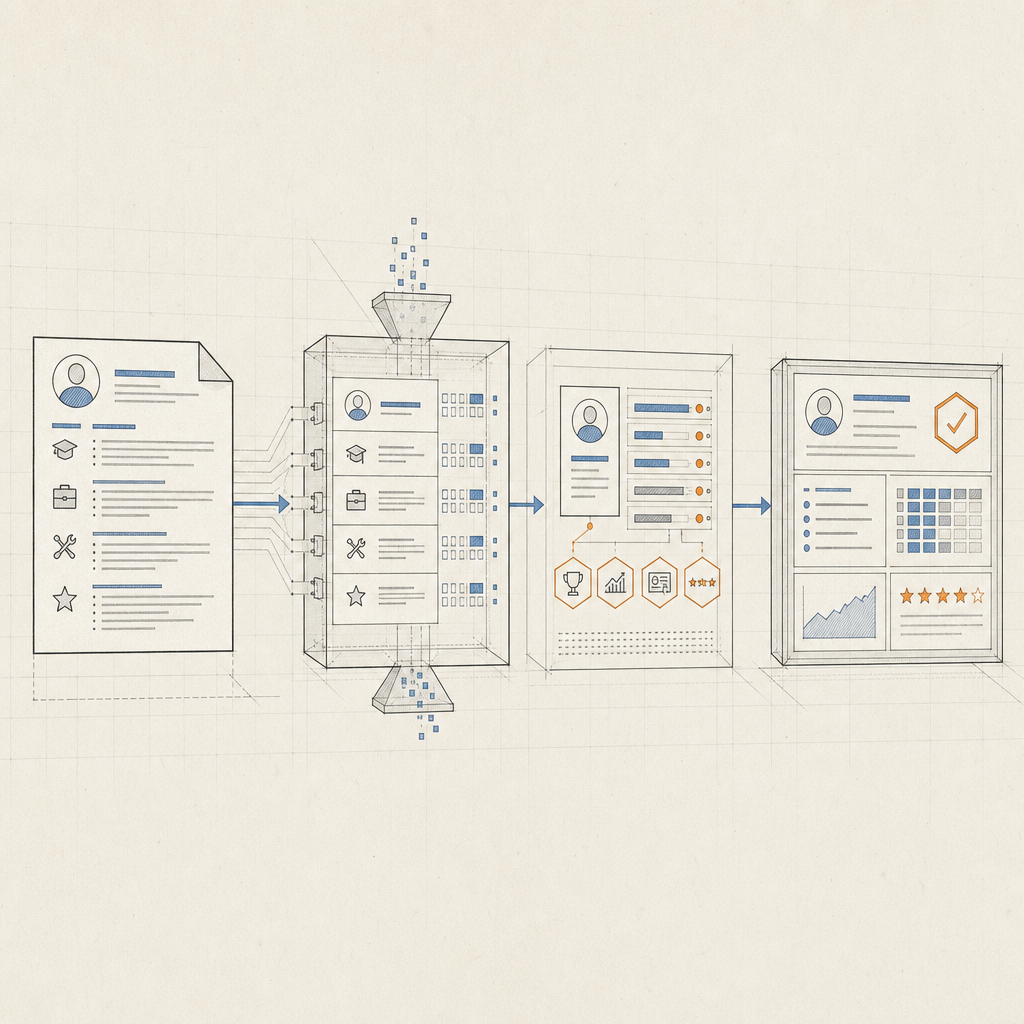
The funnel explains why clarity matters before design.
How do resume trends differ for product, startup, SaaS, and FAANG roles?
The same resume trend can look different depending on the pipeline. A clean resume that works for a startup founder-review loop will not always be the same resume that performs best in a FAANG process.
| Hiring environment | What gets rewarded | What loses points |
|---|---|---|
| Product companies | Product thinking, outcomes, cross-functional work | Vague ownership, fluffy claims |
| Startups | Speed, adaptability, scrappy shipping | Overly padded histories, slow narratives |
| SaaS companies | Revenue-adjacent impact, retention, lifecycle work | Generic “helped the team” bullets |
| FAANG-style pipelines | Structure, depth, scale, signal density | Clutter, weak metrics, unclear scope |
For product-company resumes, the best bullets usually show decisions and outcomes: launched a feature, changed a funnel, improved activation, reduced churn, or coordinated across design and engineering. For SaaS candidates, customer outcomes and growth metrics matter a lot because they connect your work to business results. For startup resumes, compressed storytelling wins because the reader wants to know whether you can move fast and still stay sharp.
FAANG-style hiring is stricter about clarity than style. It tends to reward tight structure, strong action verbs, and obvious scale. That does not mean you need to sound robotic. It means every bullet has to carry useful information.
What should you keep from older resume advice?
Not every older rule is dead. Some fundamentals still hold up because they were never trend-based in the first place.
Keep strong verbs, but use them with evidence. Keep concise bullets, but make them specific. Keep clean structure, but do not worship a template. Keep the Harvard resume format as a reference, but treat it like scaffolding, not gospel.
The best older advice still helps in 2026 when it is adapted to modern screening behavior:
- Relevance beats completeness.
- Readability beats cleverness.
- Specific outcomes beat broad responsibilities.
- One resume rarely fits every role.
The real mistake is overcorrecting. Some candidates hear “trends changed” and immediately strip away useful structure or add trendy sections that do not help. The better move is to preserve what makes the resume easy to read and upgrade what makes the resume convincing.
How do these trends affect submission and screening?
Submission format is part of the trend now because the funnel itself is part of the resume experience. A resume that is technically strong but badly submitted can still underperform.
The safest path is simple: submit a clean PDF unless the portal asks for another format, keep file names professional, and make sure section labels are standard enough for applicant tracking systems to read without guesswork. If a portal asks you to paste text, assume formatting will degrade and make sure the content still reads well in plain text.
Recruiter screening is also why modern resumes lean toward machine-readable simplicity. A few years ago, a clever design could help you stand out. In 2026, that same design often creates friction. The more your document behaves like structured text, the more reliably it survives the first filter.
A practical submission checklist:
- [ ] Export a clean PDF.
- [ ] Test how the resume reads when copied into plain text.
- [ ] Make sure dates, titles, and company names are consistent.
- [ ] Avoid nonstandard section names if you need ATS compatibility.
- [ ] Check that LinkedIn matches the core story.
What should tech candidates do next?
Start by stripping your resume down to the evidence that matters. Remove decorative clutter, vague bullets, and anything that does not help a recruiter understand your fit in under a minute.
Then rebuild around the 2026 stack: a clean format, a short summary, a strong skills section, and bullets that show measurable impact. If you are applying to product, startup, SaaS, or FAANG-style roles, tailor the order and emphasis to the job instead of sending the same version everywhere.
Trim weak bullets, tighten metrics, and align the resume to one target role. That is the move that makes the document easier to parse, easier to trust, and harder to ignore.