
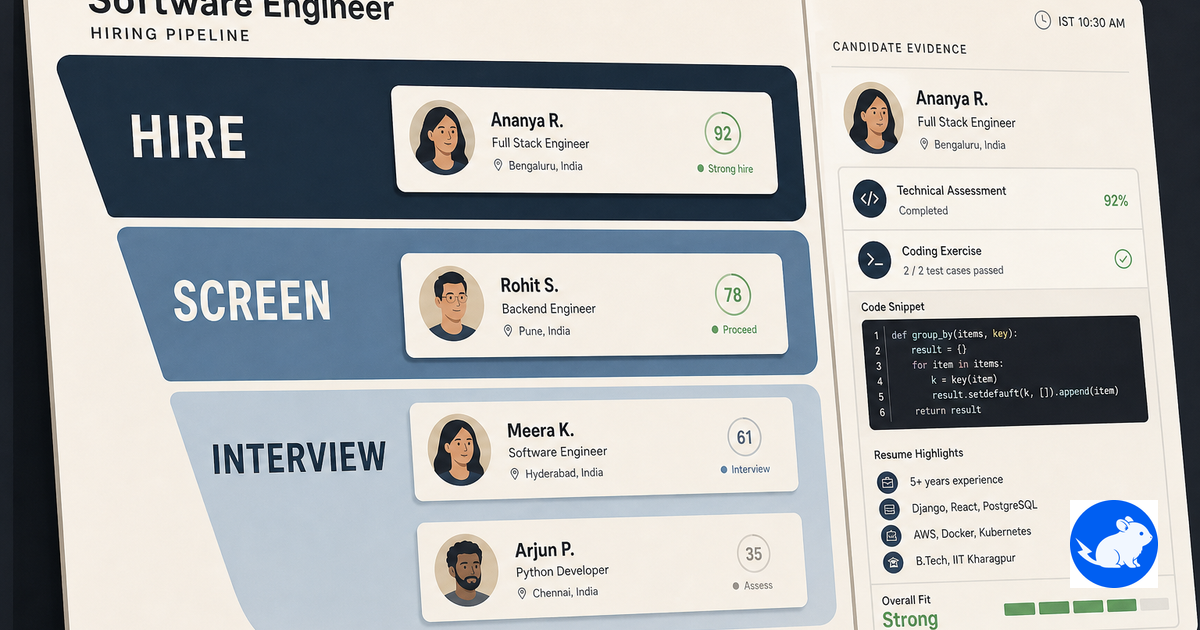
How to Hire Software Engineers: A Practical Playbook
Last updated: 2026-07-06
As of July 2026, teams that need to hire software engineers need a process, not a pile of resumes. The fastest path is simple: define the role, source from the right places, screen for evidence, and tailor the job description so the right candidates actually respond. Pika Resume helps job seekers build ATS-friendly resumes, but this playbook is for the hiring side: how to attract, assess, and close engineers without wasting weeks.
Key takeaways
- Hire software engineers by starting with the role, not the applicant pool.
- LinkedIn and GitHub are high-signal channels, while marketplaces like Upwork, Turing, and Lemon.io work best with structured screening.
- India-specific hiring works best when you combine local sourcing, referral paths, and clear job-description matching.
- Technical screening should mirror the real work, not interview theatre.
- A tight offer process closes strong candidates faster than a longer funnel.
How to hire software engineers?
Hire software engineers by defining the role, sourcing from the right channels, screening for evidence of impact, running structured technical interviews, and closing with a clear offer process. For startup teams hiring in India or globally, the goal is the same: build a shortlist of engineers who match the job description, not just a stack of polished resumes.
- Define the role. Decide whether you need product engineering, platform, mobile, data, DevOps, or full stack.
- Source with intent. Use LinkedIn, GitHub, referrals, and India-relevant networks before you widen into marketplaces.
- Screen for signal. Look for shipped work, measurable outcomes, and stack fit.
- Assess with structure. Use technical screening that maps to the actual job.
- Close fast. Keep feedback loops short and make the offer easy to understand.
If you want a deeper India-specific sourcing and closing guide, this India hiring playbook is the closest companion piece.
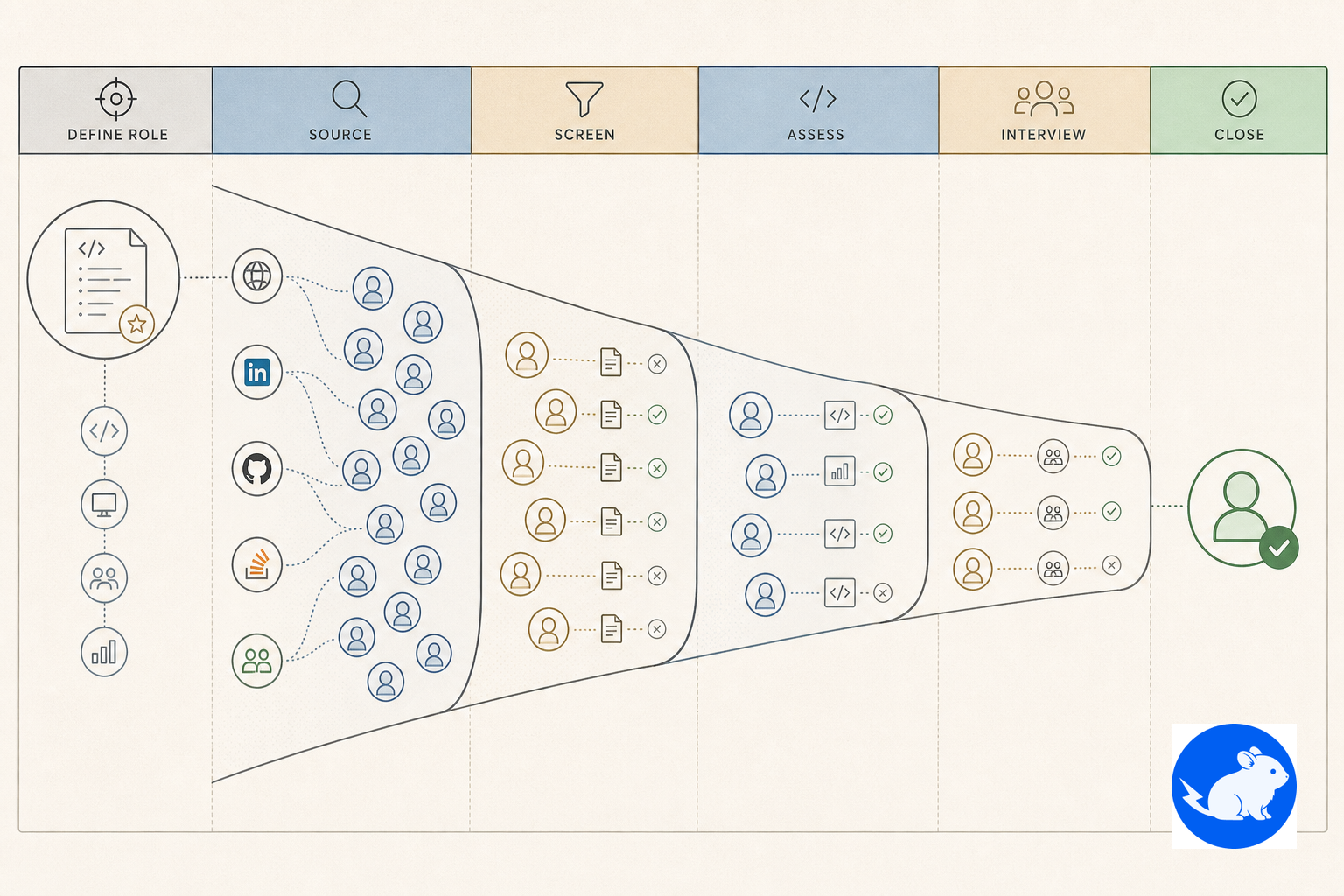
A simple sequence keeps the funnel tight and repeatable.
Example: A startup hiring its first backend engineer should not ask for every cloud skill under the sun. It should specify the stack, the product stage, the expected time zone overlap, and the first 90-day outcomes. That makes candidate matching cleaner and the interview loop shorter.
Define the role before you post or search
A precise role spec cuts wasted interviews and improves candidate quality. Before you post anything, map the work to a real engineering lane, then write the job around that lane instead of around a generic title.
Build the spec around these inputs:
- Must-haves: language, framework, cloud platform, or domain experience that truly matters.
- Nice-to-haves: things that help, but should not block a strong hire.
- Seniority: junior, mid-level, senior, or staff, based on scope and ownership.
- Time zone overlap: especially important for distributed teams hiring in India.
- Team context: product squad, infra team, client work, or greenfield build.
- Job-description matching criteria: the signals a candidate should see to self-select quickly.
The best role descriptions are honest about the work. If the role is mostly bug fixing and API maintenance, say that. If it is heavy on system design and mentoring, say that too. That transparency improves response quality and saves everyone time.
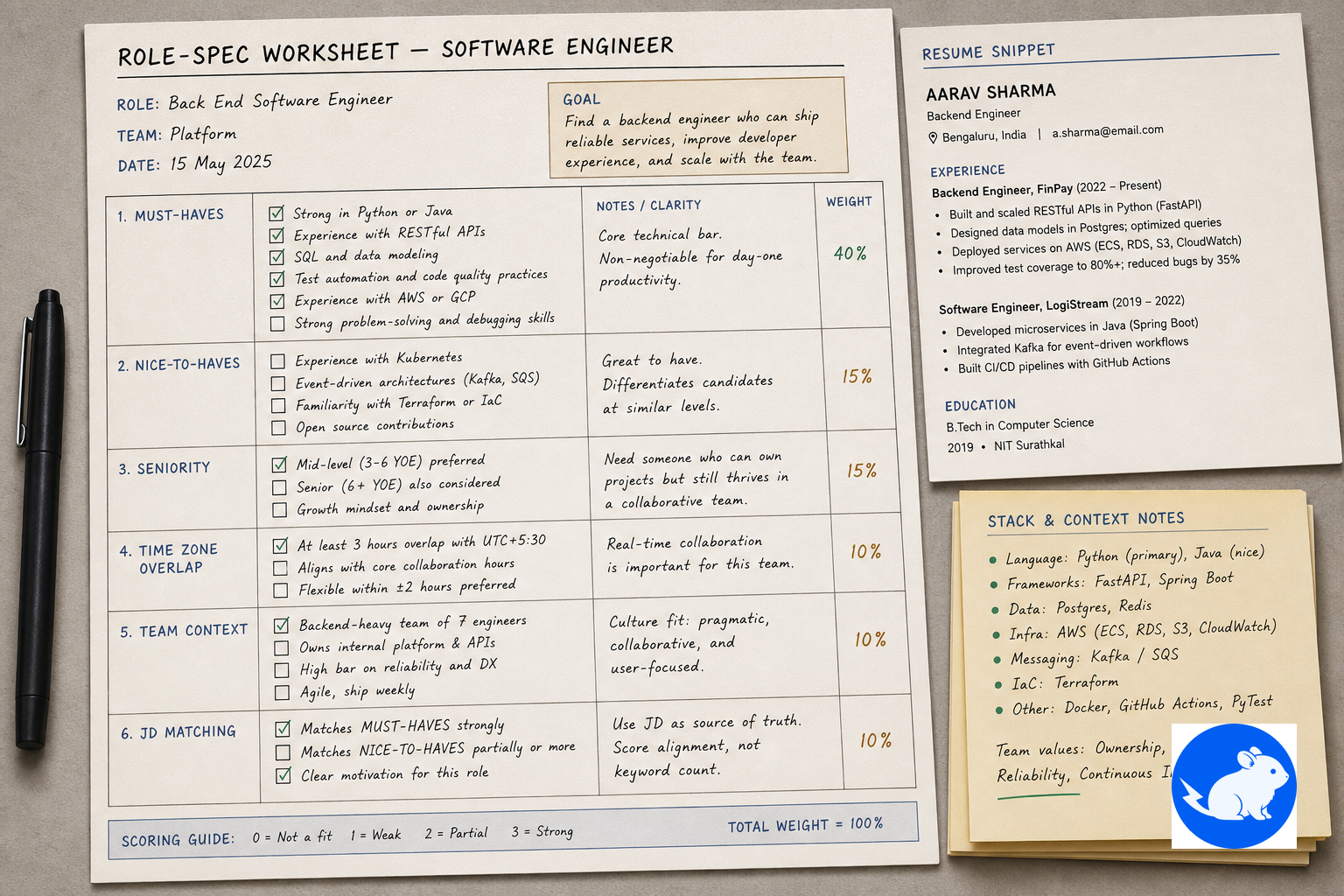
A clear brief turns a vague request into a usable job spec.
Tip: Write the role as if a strong engineer is scanning it between meetings. If the first paragraph does not tell them what they would build, what they would own, and why it matters, it is too vague.
Where to hire software engineers?
You can hire software engineers from LinkedIn, GitHub, referrals, specialist communities, marketplaces, and your own talent pool. The right channel depends on how fast you need someone, how much signal you want, and how much screening time you can spend.
| Channel | Best for | Signal quality | Speed |
|---|---|---|---|
| Broad reach and outbound sourcing | Medium to high | Fast | |
| GitHub | Code activity and technical credibility | High | Medium |
| Referrals | High-fit candidates with context | High | Fast |
| Upwork | Contractors and short-term projects | Mixed | Fast |
| Turing | Marketplace-style remote hiring | Mixed to high | Fast |
| Lemon.io | Faster contractor sourcing | Mixed | Fast |
LinkedIn works well when you want reach and direct outreach. GitHub helps validate whether the person actually ships code, not just buzzwords. Referrals are often the cleanest path for trust. Upwork, Turing, and Lemon.io can be useful when speed matters, but they should not replace structured screening.
For India-specific hiring, the strongest mix is usually local referrals, LinkedIn outreach, and remote-friendly communities. That combination gives you reach without turning the process into a random marketplace feed.
How to recruit and hire great software engineers?
Great hiring follows a repeatable sequence: source, screen, assess, interview, compare, and close. The more consistent that sequence is, the easier it is to judge candidates fairly and avoid false positives.
- Source the shortlist. Start with LinkedIn, GitHub, referrals, and relevant communities.
- Review the evidence. Scan the resume, portfolio, and public code for real outcomes.
- Run technical screening. Use a short, role-matched screen instead of a generic puzzle set.
- Interview on the work. Ask scenario questions that mirror the actual job.
- Compare candidates side by side. Use the same scorecard for everyone.
- Close with clarity. Explain the role, growth path, compensation, and timeline.
If your team is hiring in India, keep the communication tight and the feedback loops short. Strong candidates often compare multiple offers, so a slow process can cost you the hire even when your role is a good fit.
Screen for signal, not just keywords
Strong screening looks for shipped products, measurable impact, stack relevance, and problem-solving depth. A resume can be ATS-friendly and still be weak on substance, so the resume is only the starting point.
Use this quick check:
- Shipped work: Did the candidate build something that went live?
- Measurable impact: Can they point to speed, reliability, revenue, or user-growth outcomes?
- Stack relevance: Have they worked in the technologies your team actually uses?
- Depth: Can they explain trade-offs, not just list tools?
- Consistency: Does the resume, portfolio, and GitHub activity tell the same story?
GitHub is especially useful when the role needs real engineering proof. Not every strong engineer has a perfect public profile, but if the public evidence exists, it should reinforce the resume rather than contradict it. That is where a structured ATS review and manual screening work best together.
Run technical screening that matches the job
Technical screening should reflect the real work the engineer will do. If the role is backend-heavy, the screen should test API design, debugging, data handling, and maintainability. If it is frontend-heavy, you want component thinking, state management, and performance trade-offs.
A practical screen often includes three parts:
- A short coding task. Keep it bounded and realistic.
- A discussion of trade-offs. Ask why they chose one approach over another.
- A scenario from your codebase. Use a problem that resembles your actual product.
For a mid-level engineer, 60 to 90 minutes is usually enough to get useful signal without making the process feel like unpaid labor. For senior roles, a system-design discussion plus a code review exercise often reveals more than a long algorithm test.
Warning: Do not turn technical screening into interview theatre. A candidate who can solve contrived puzzles may still struggle with debugging a live system, reviewing pull requests, or working with product constraints.
Use job-description matching to personalize outreach and offers
JD matching helps tailor messages so candidates see why the role fits them. When the pitch mirrors their experience, response rates improve and the conversation feels less generic.
Match the candidate’s background to these parts of the job:
- Stack: the languages, frameworks, and tools they already know.
- Product stage: early startup, growth stage, or enterprise.
- Scope: ownership, mentoring, architecture, or execution.
- Growth path: what they will learn in the next 12 months.
This is also where AI rewriting can help. Use it to adapt the same opportunity for different profiles without sounding copy-pasted. A backend engineer and a full-stack engineer should not get the same outreach note, even if they are being considered for the same team.
Compare hiring channels and decide what to use first
The best channel mix depends on speed, signal quality, and effort. If you start with the wrong source, you usually pay for it later in screening time.
| Criterion | GitHub | Upwork | Turing | Referrals | |
|---|---|---|---|---|---|
| Speed | High | Medium | High | High | High |
| Signal quality | Medium to high | High | Mixed | Mixed to high | High |
| Screening effort | Medium | Medium | High | High | Low to medium |
| Best use | Outbound sourcing | Technical validation | Short projects | Remote hiring | High-fit candidates |
| Startup fit | Strong | Strong | Good for gaps | Good for speed | Very strong |
For most teams, the best order is LinkedIn first, GitHub second, referrals in parallel, then a marketplace only if the funnel needs more volume. That mix gives you control without ignoring speed. If you are comparing other hiring workflows in India, the adjacent design hiring guide shows a similar principle: source broadly, screen tightly, and close with clarity.
Common mistakes when hiring software engineers
The most common hiring mistakes are vague job descriptions, unstructured interviews, and weak technical screening. Those three issues create the same outcome: too many conversations, too little signal.
- Vague scope: The role sounds broad, but the work is not.
- Pedigree bias: The team overvalues brand names and undervalues actual delivery.
- Slow feedback: Strong candidates disappear when decisions take too long.
- Unclear compensation: The offer range is hidden until late in the process.
- Poor candidate experience: Long forms, unclear next steps, and delayed replies hurt trust.
In India, candidate experience matters even more because good engineers often have multiple active options. If your process is slow or confusing, your strongest people will move on.
What companies hire software engineers?
Software engineers are hired by startups, SaaS companies, enterprise tech teams, agencies, product companies, and consulting firms. The best-fit employers usually have a clear product problem, visible engineering work, and a hiring process that shows respect for the candidate’s time.
This matters for recruiters because the company type changes the pitch. A startup should sell ownership and speed. An enterprise team should sell scale and stability. A consulting firm should sell variety and client exposure. If you match the message to the environment, your outreach feels relevant instead of generic.
It also matters for job seekers reading this guide. If the market is crowded, engineers with strong GitHub proof, an ATS-friendly resume, and clear project outcomes tend to stand out faster than people who only list tools.
Frequently asked questions
How do you hire software engineers fast without lowering quality?
You hire software engineers fast by narrowing the role, using high-signal channels, and keeping the interview loop short. A 3-step process, source, screen, technical interview, is usually faster and cleaner than a sprawling panel. The key is to decide what “good” looks like before you start.
What companies hire software engineers in India?
Startups, product companies, SaaS firms, services firms, consultancies, and global remote teams all hire software engineers in India. The strongest opportunities usually come from companies with real product work, clear ownership, and a defined hiring process.
Where should a startup hire software engineers first?
A startup should usually start with LinkedIn, referrals, and GitHub before expanding to marketplaces. That mix gives you reach, trust, and technical evidence. If speed becomes the bottleneck, then platforms like Upwork, Turing, or Lemon.io can fill gaps.
How do you recruit and hire great software engineers?
You recruit and hire great software engineers by using a consistent funnel: source, screen, assess, compare, and close. Every step should be tied to the actual work the engineer will do. That keeps the process practical and reduces bad-fit hires.
How do you know if a resume is good enough for screening?
A good resume shows shipped work, measurable impact, and role-relevant skills in a clean structure. It does not need to be flashy. It needs to be readable, specific, and consistent with the candidate’s portfolio or code history.